Dance Moves | 18 Jan - 15 Feb 2026
Dance Moves | 18 Jan - 15 Feb 2026An exhibition dedicated to the relationship between illustration, cities, and walking, where you can discover drawing and comics as creative tools for urban research.
DRAWING CITIES
Drawing in the city is a form of exploration that reveals how movement through space is far more than a simple act of getting from one point to another. In the line traced on the page, pencil and moving body, the space traversed and the gaze that crosses it come together in a single intertwining. Too often, the drawing of the city is delegated to a technical domain, as if urban design were merely a set of volumes and orthogonal lines that establish flows and organize, or exclude, bodies. There is another way of thinking about urban drawing, one that draws on anthropologist Tim Ingold’s idea of the line as movement, where body and thought, action and imagination meet.
The idea of graphic geography takes up this challenge, adopting comics, live sketching, and illustration as methodologies for urban research. If walking is already a way of paying attention, drawing cities is a transformative act. Drawing while walking makes it possible to translate the trajectories of moving bodies into stories that leave traces of our passage on the page. Drawing is an immersive experience, a narrative of the city, a transformative action, both an urban portrait and a project.
DANCE MOVES
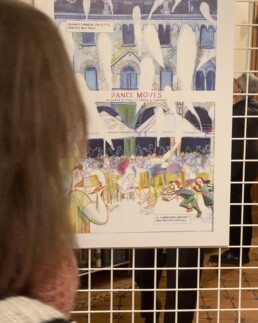
Illustrations by Tânia A. Cardoso
Texts by Giada Peterle and Tânia A. Cardoso
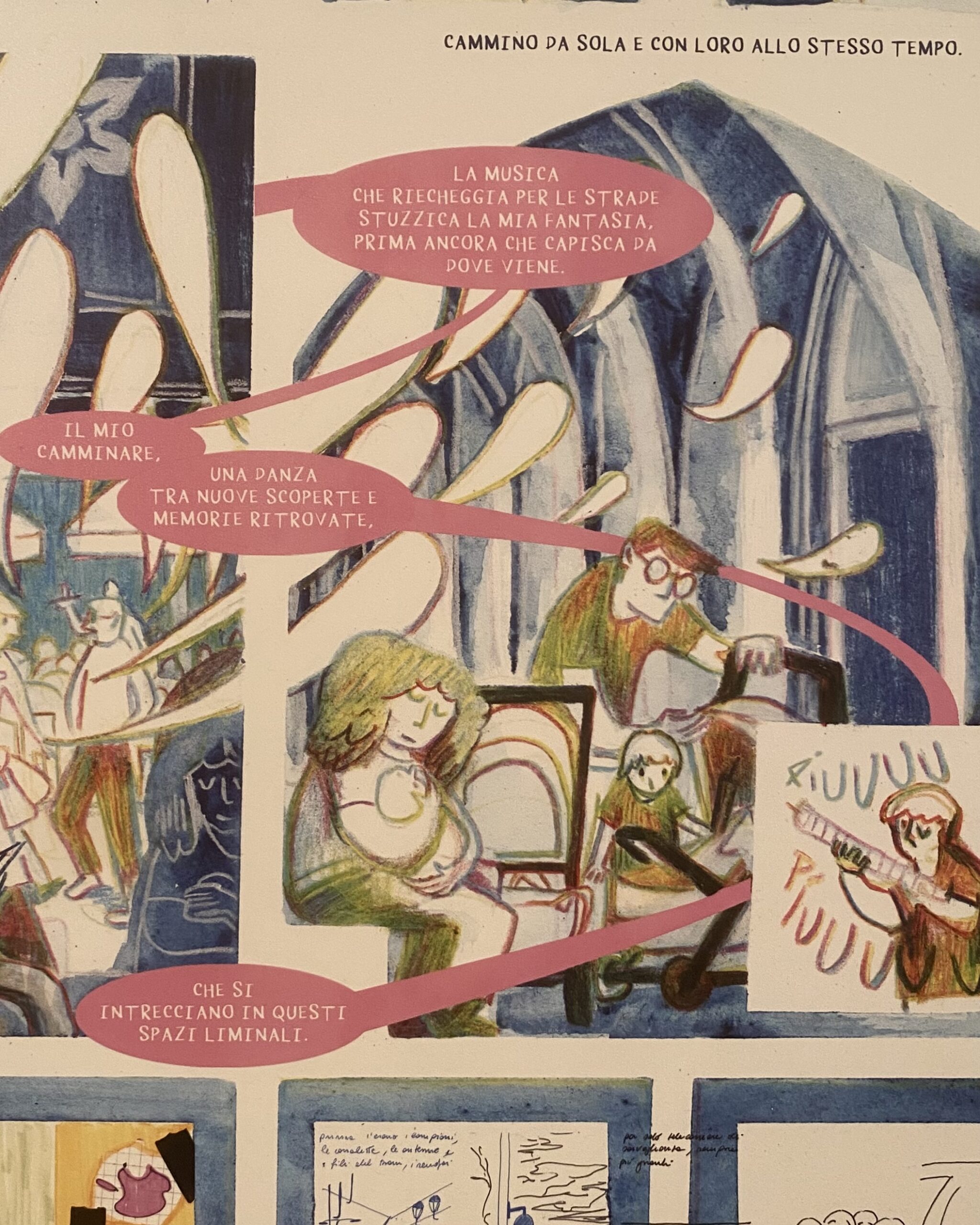
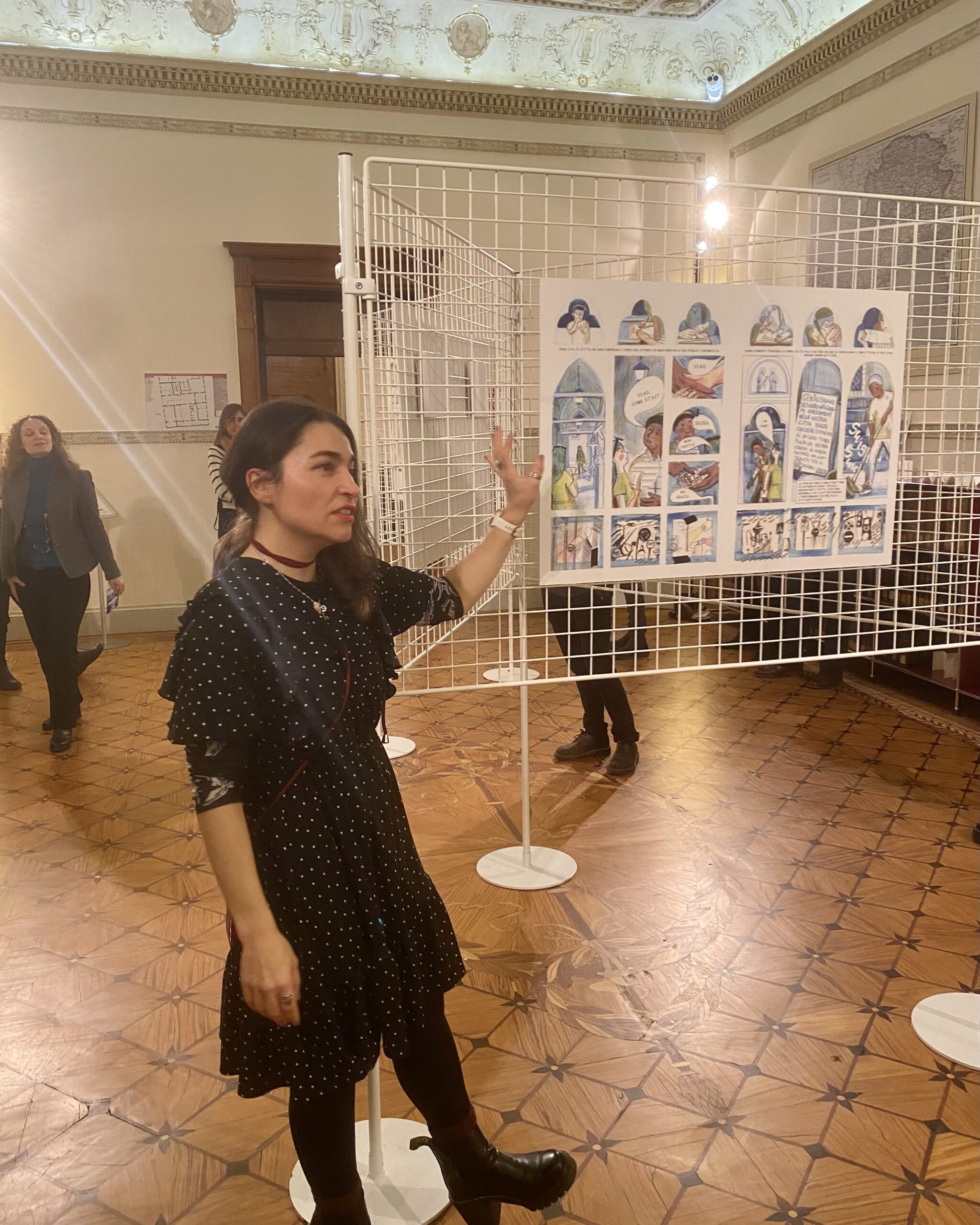
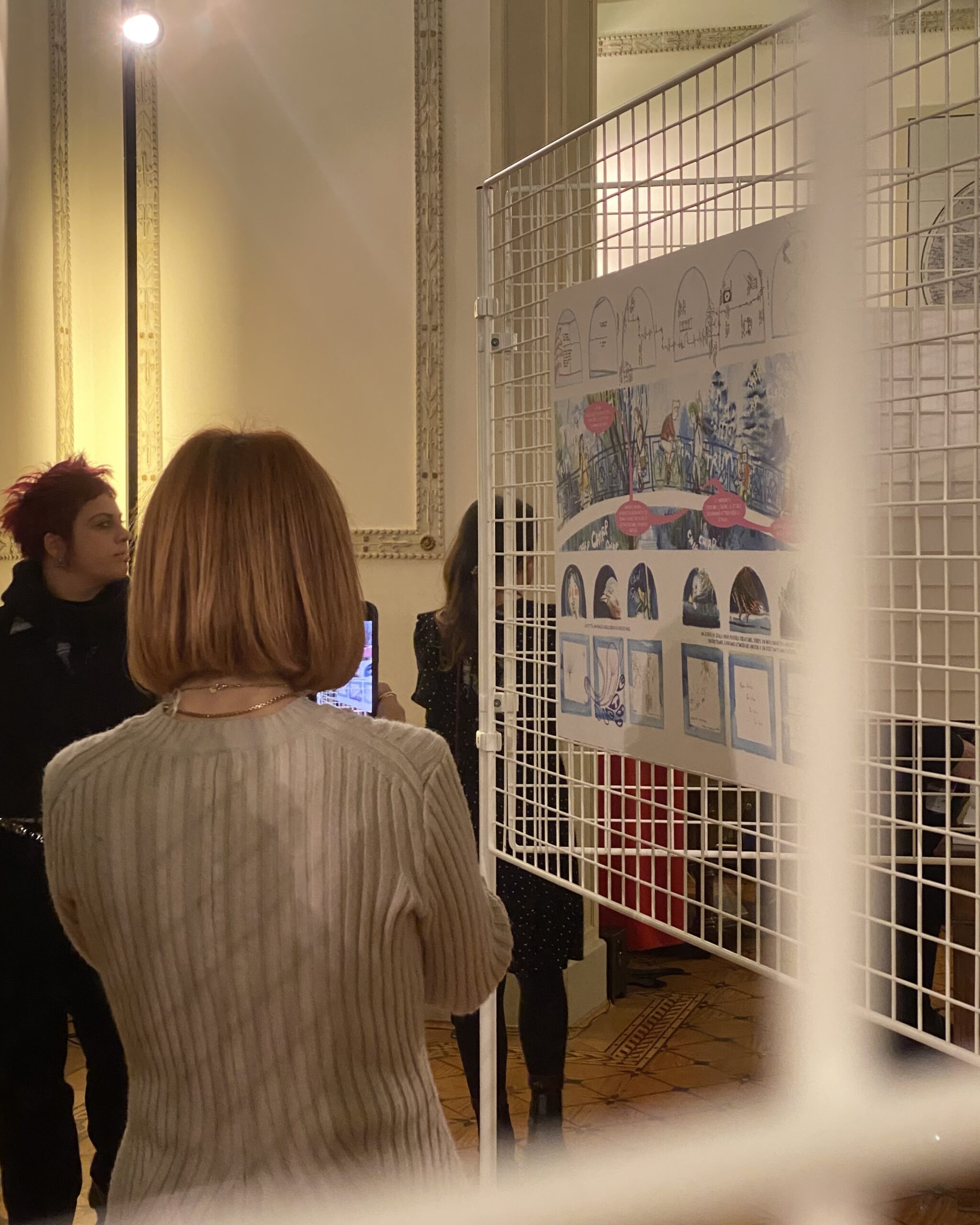
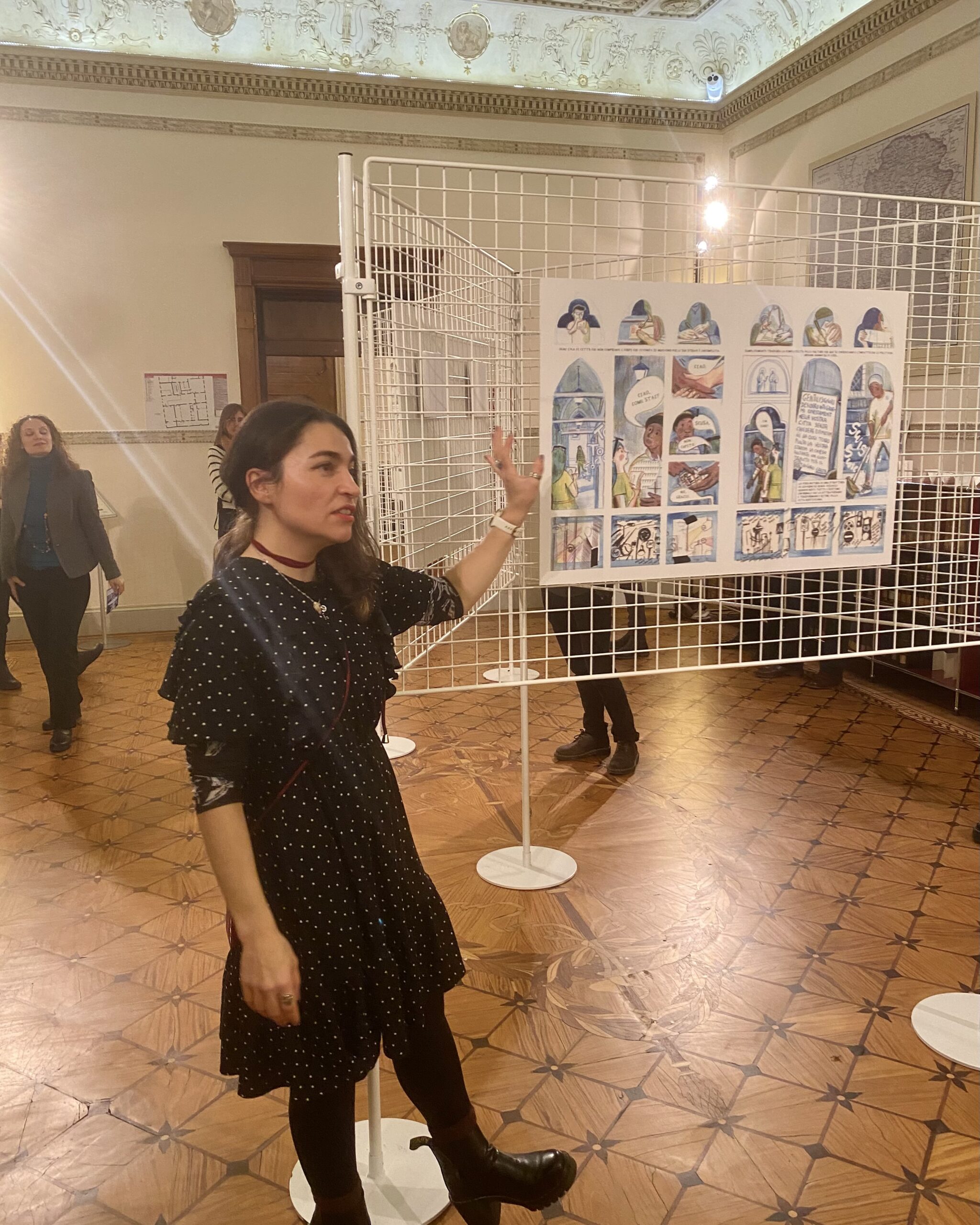
The graphic story Dance Moves emerges from a dialogue between architecture, geography, and graphic languages. It is the result of a walking-based workshop held in April 2025, involving students of the Master’s Degree Programme in Landscape Sciences and members of the public. The walkshop promoted a collaborative approach to the production of stories in motion. The structure of the panels visually embodies this idea by dividing the reading into three narrative lines. The first retraces the actions carried out while walking through the city, such as drawing, exploring, and conversing. The second focuses on the illustrator’s experience and point of view. The third incorporates fragments of the participants’ stories, integrating multiple perspectives into a narrative that is both intimate and plural.
IN FOCUS
Urban Mappings
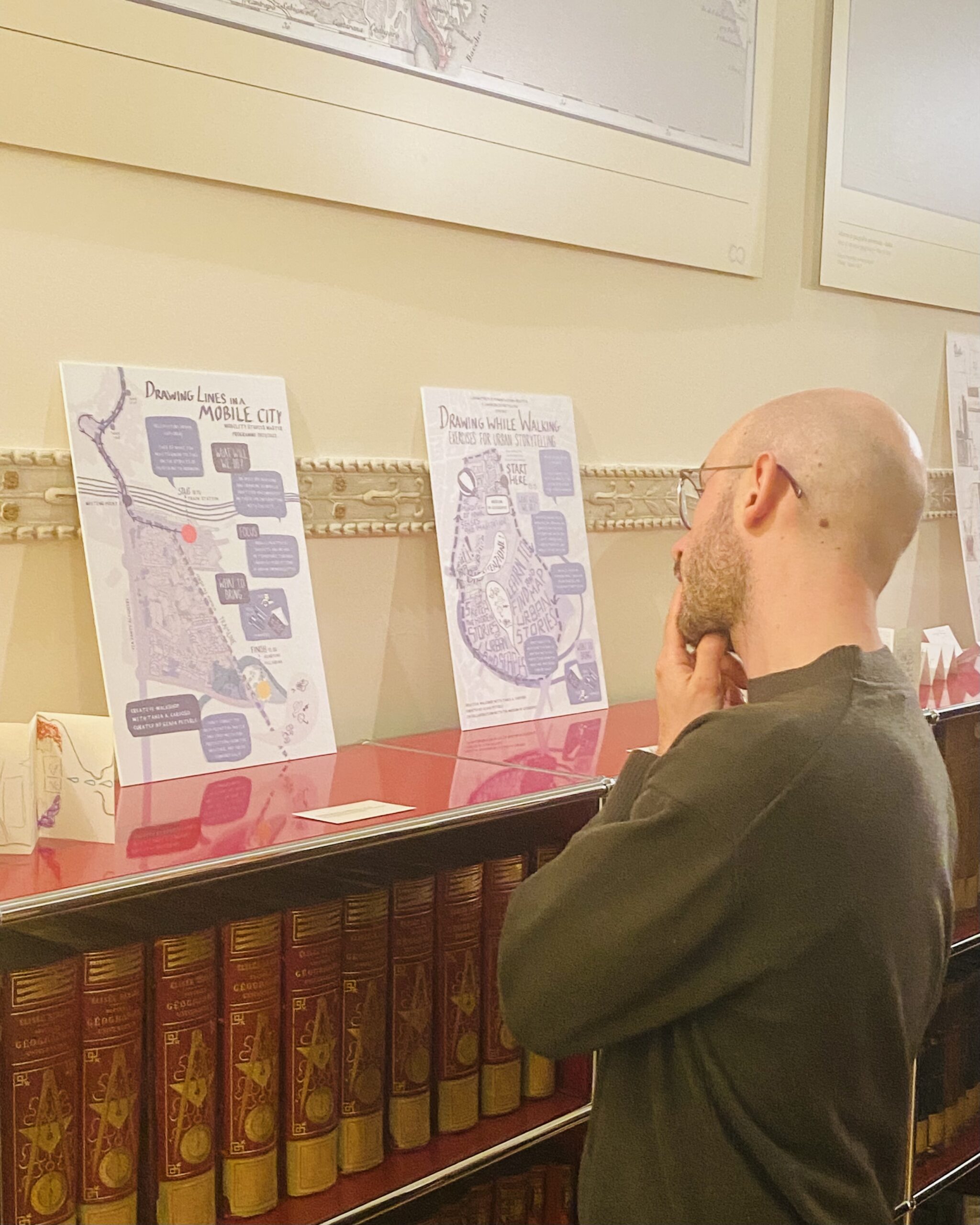
What should a city map represent? Which bodies, desires, voices, and dreams have the right to inhabit it? Cartography is not a technical language reserved for a few, but a dynamic tool accessible to every inhabitant. Walking in the city is a method for collecting narrative prompts and building creative cartographies through field research and urban sketching sessions. Alongside drawings of streets and buildings, Cardoso’s maps incorporate comics and illustrations, enlivened by colours and sounds. They suggest actions to liberate the gaze. By welcoming sounds, smells, and voices, the map is no longer a static plan projecting an orthogonal vision of space, but a living, dynamic place to be inhabited by walking. In this selection, original maps propose itineraries, exercises, and inspirations for drawing while walking in the cities of Padua, Rotterdam, and Amsterdam.
Creative Process
The sketchbook is a meeting place where drawing, gaze, and city intertwine, finding a shared graphic language. Here the first steps are taken so that notes made while walking and observing can later become a story; here fragments of the narrative are collected and then recomposed into intricate paths.
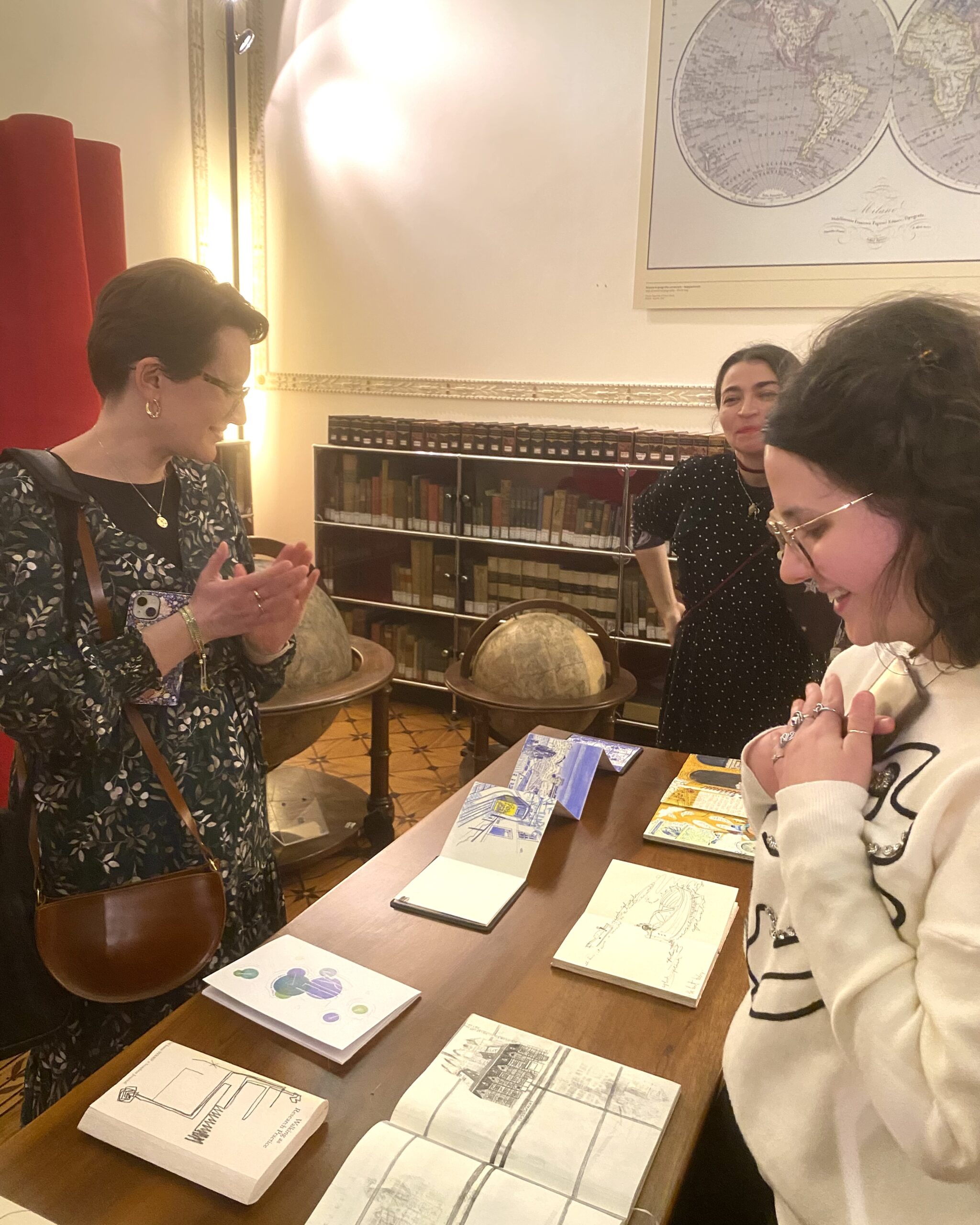
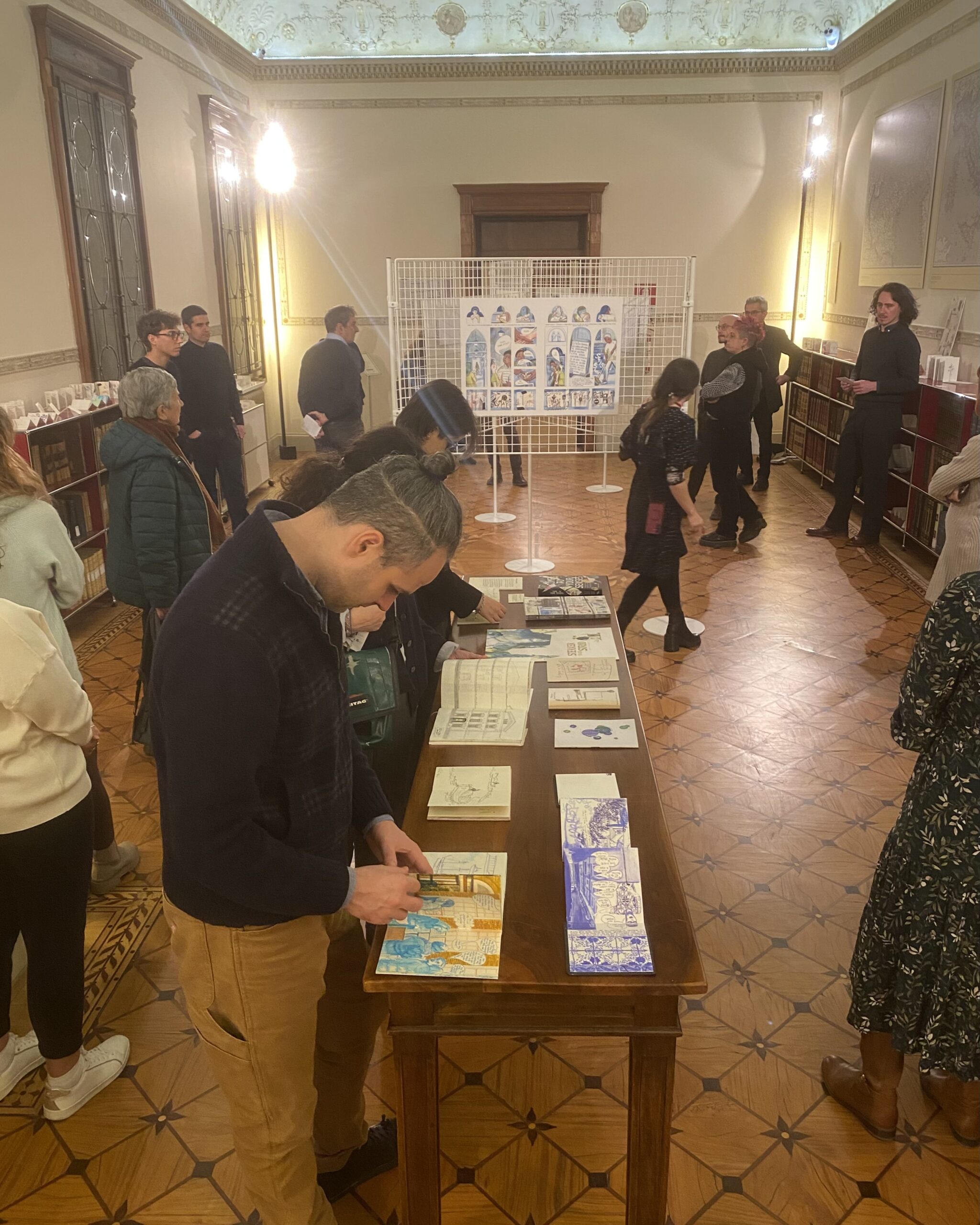
Cardoso’s sketchbooks, exhibited together with her publications, make it possible to trace this process of reworking, from the spontaneous capture of fleeting marks drawn during field research to the complex forms those initial notes take once translated into book form. Following the lines on these pages means entering the creative process: recognizing returns, detours, obstacles, and erasures, leading to the construction of a narrative thread.
An opportunity to observe how thought, from urban sketching to the printed page, can move away from the actual route to open up new paths.
Notes
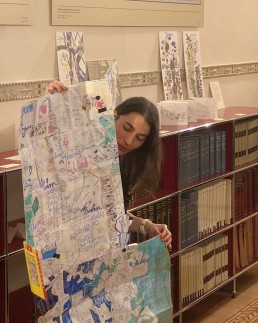
Created by participants in the walking graphic workshop held in April 2025, the accordion-fold sketchbooks inspired the polyphony of the Dance Moves narrative. Each one focuses on observing a material or immaterial aspect of the urban landscape, while also telling the aspirations and fears of those who traverse it. Between the folds, animalscapes, dirtscapes, technoscapes, dreamscapes, globalscapes, and other landscapes take shape.
These sketchbooks reveal the plural stratifications of walking landscapes and invite the weaving together of collective walking with the sharing of intimate and personal stories.
Among the authors:
Gaia Ballatori, Elena Barbiero, Erika Basso, Francesco Casari, Aurora Circelli, Isabela De Jesus Cadorin, Juliet Fall, Perla Franco, Filippo Milani, Giulia Molinarolo, Ginevra Montefusco, Sabrina Neri, Elisa Sella, Giorgia Vulcan, Israt Zahan Bhuiyan, Francesco Zuccolo.
Geography Museum – Exhibition
Via del Santo, 26
Duration: January 18–February 15
Tuesday from 3:00 p.m. to 6:00 p.m.
Sunday from 2:30 p.m. to 6:30 p.m.

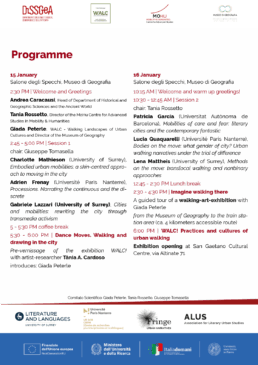
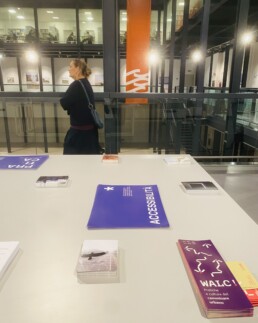
WALC! Exhibition launch | 16 Jan 2026
WALC! Exhibition launch | 16 Jan 2026
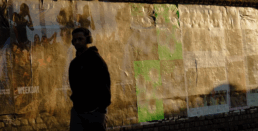
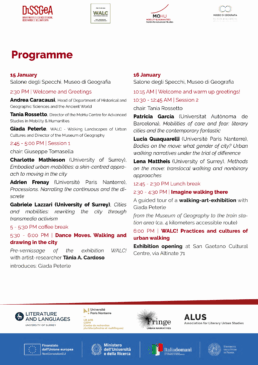
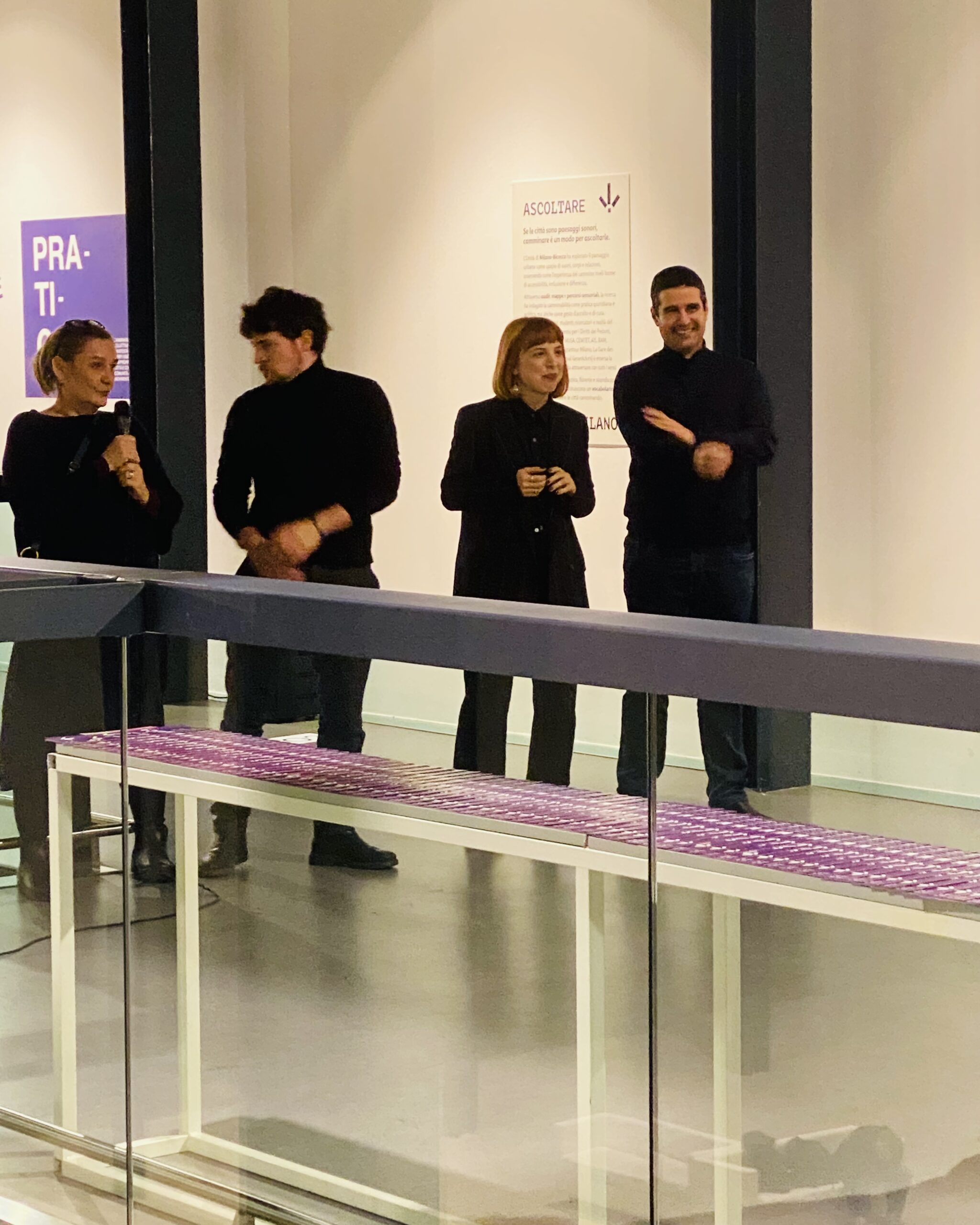
Walking is a way of observing that becomes an immersive experience of the city. It is an act of unveiling, capable of grasping, through urban metamorphoses, the signs of social and climatic change. It is also an act of rewriting, a tool for rethinking and designing urban space beyond established routes. Walking with the city and its inhabitants, human and more-than-human, is at once a political and poetic, social and intimate, critical and creative gesture. As a social practice, walking activates new communities in motion that are aware of the transformative potential of their own steps.
WALC! is an invitation to walk together in our cities.
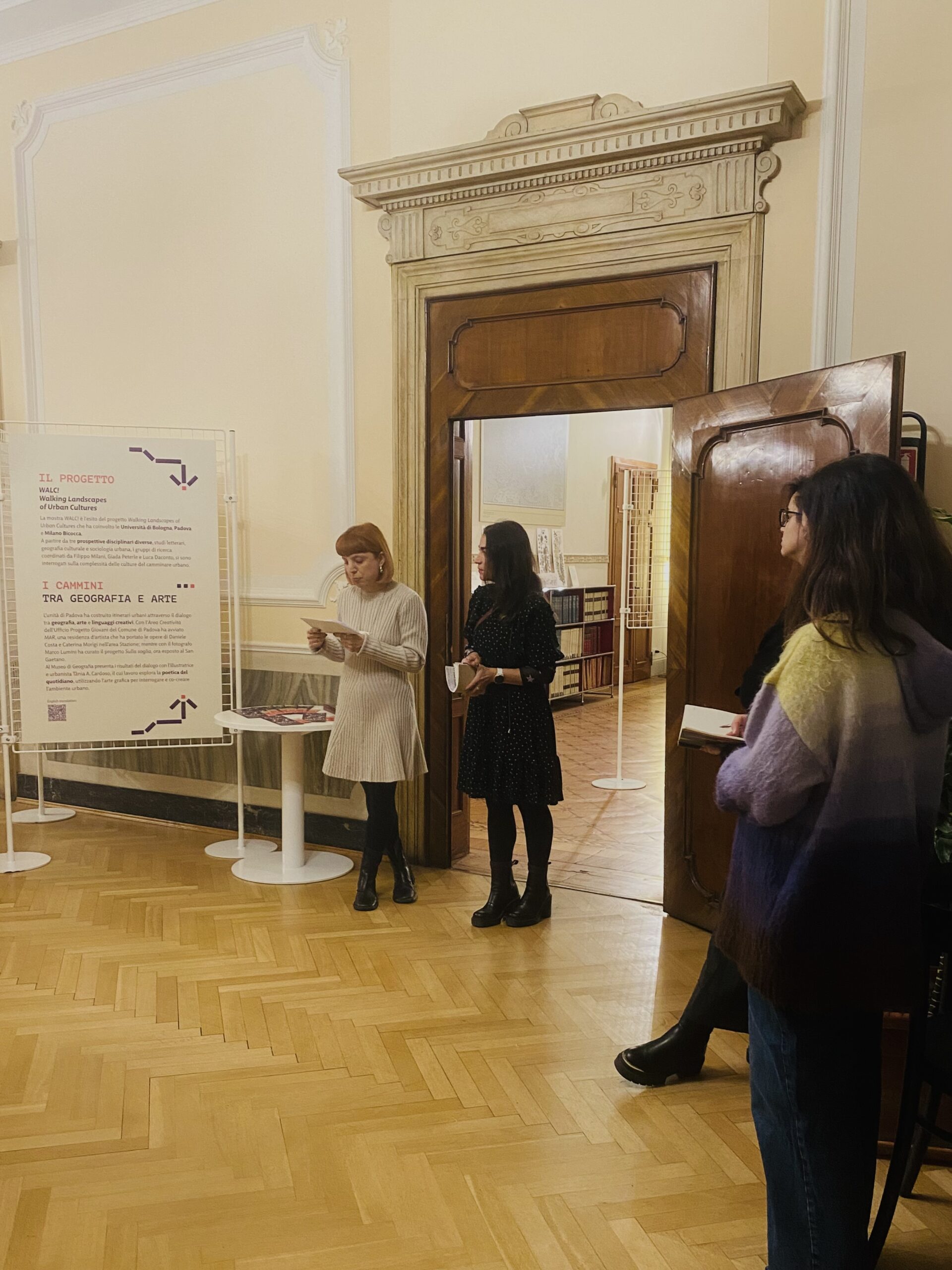
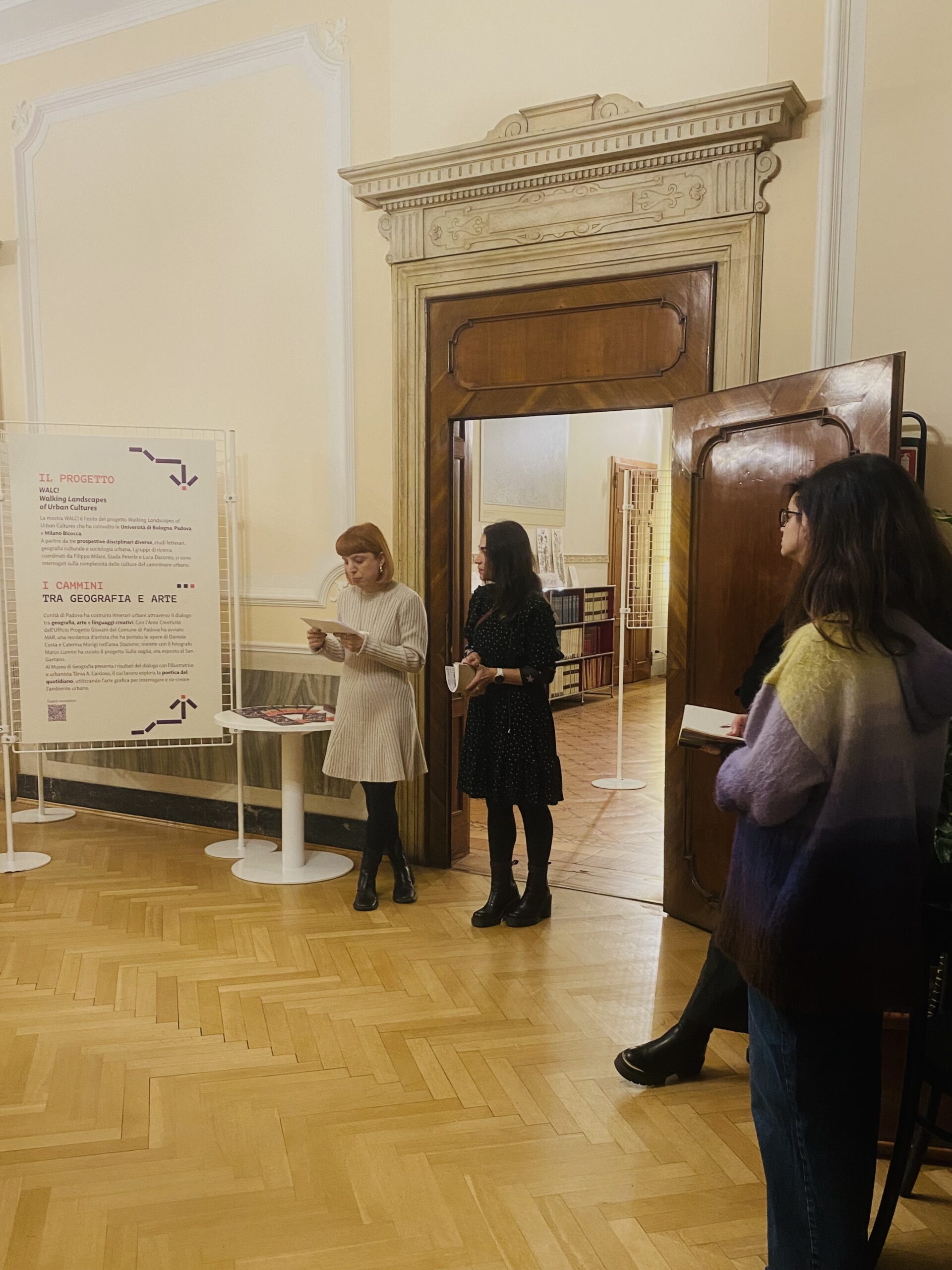
The exhibition WALC! is the outcome of the project Walking Landscapes of Urban Cultures, which involved the Universities of Bologna, Padua, and Milan Bicocca. Drawing on three different disciplinary perspectives, literary studies, cultural geography, and urban sociology, the research groups coordinated by Filippo Milani, Giada Peterle, and Luca Daconto investigated the complexity of urban walking cultures through transdisciplinary methodologies.
The exhibition itinerary winds its way through the transdisciplinary restitutions of the three research units, which have interpreted their cities as living laboratories for listening to, recounting, and imagining the cultures of urban walking.
Using different languages, each city contributes to the unveiling of new perspectives for those who walk in the city and observe landscapes in constant transformation.
Between Geography and Art
The Padua research unit developed urban itineraries through an open dialogue between geography, art, and creative languages. In collaboration with the Creativity Area of the Progetto Giovani Office of the Municipality of Padua, the Padua research unit launched MAR (Mobile Art Residency), an artist residency that led to the permanent installation of public artworks by Daniele Costa and Caterina Morigi in the train station area.
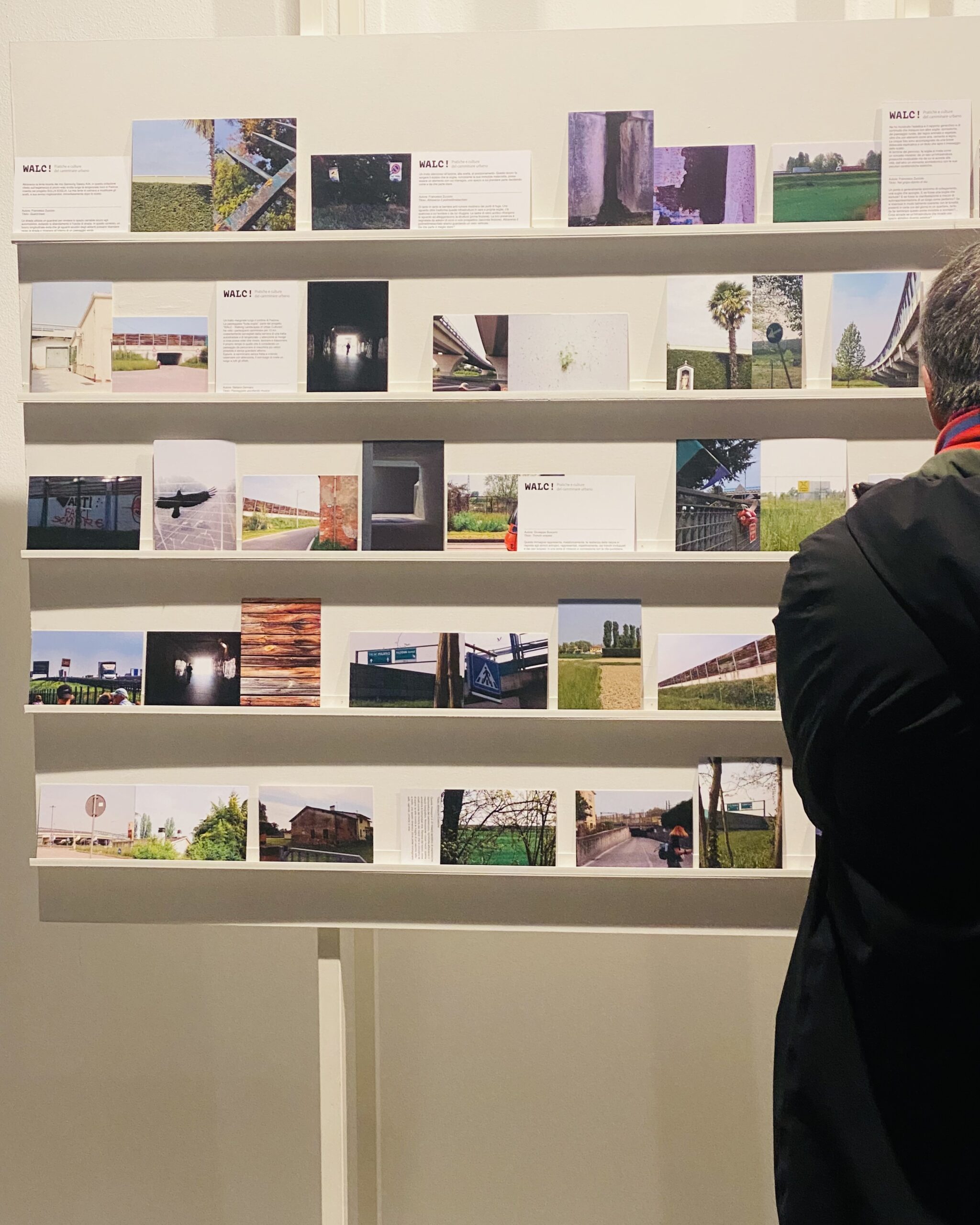
Together with photographer Marco Lumini, the research unit curated the project Sulla soglia, exhibited at San Gaetano Cultural Centre.
At the Museum of Geography, we present the results of a dialogue with illustrator and urban researcher Tânia A. Cardoso, whose work explores the poetics of everyday life, using graphic art to question and co-create the urban environment.
Exhibition venues
Altinate S. Gaetano Cultural Center – Exhibition | Via Altinate 71, Padua
Opening: January 16, 2026, at 6:00 p.m.
Duration: January 16-February 15
Free admission exhibition
Tuesday to Sunday | 9:00 a.m. to 7:00 p.m.
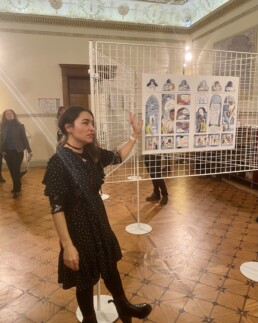
Dance Moves Opening | 15 Jan 2026
Dance Moves Opening | 15 Jan 2026
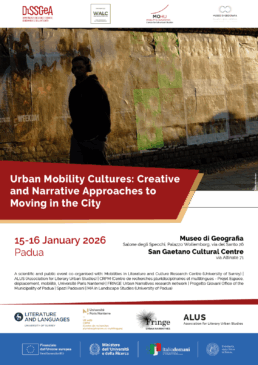
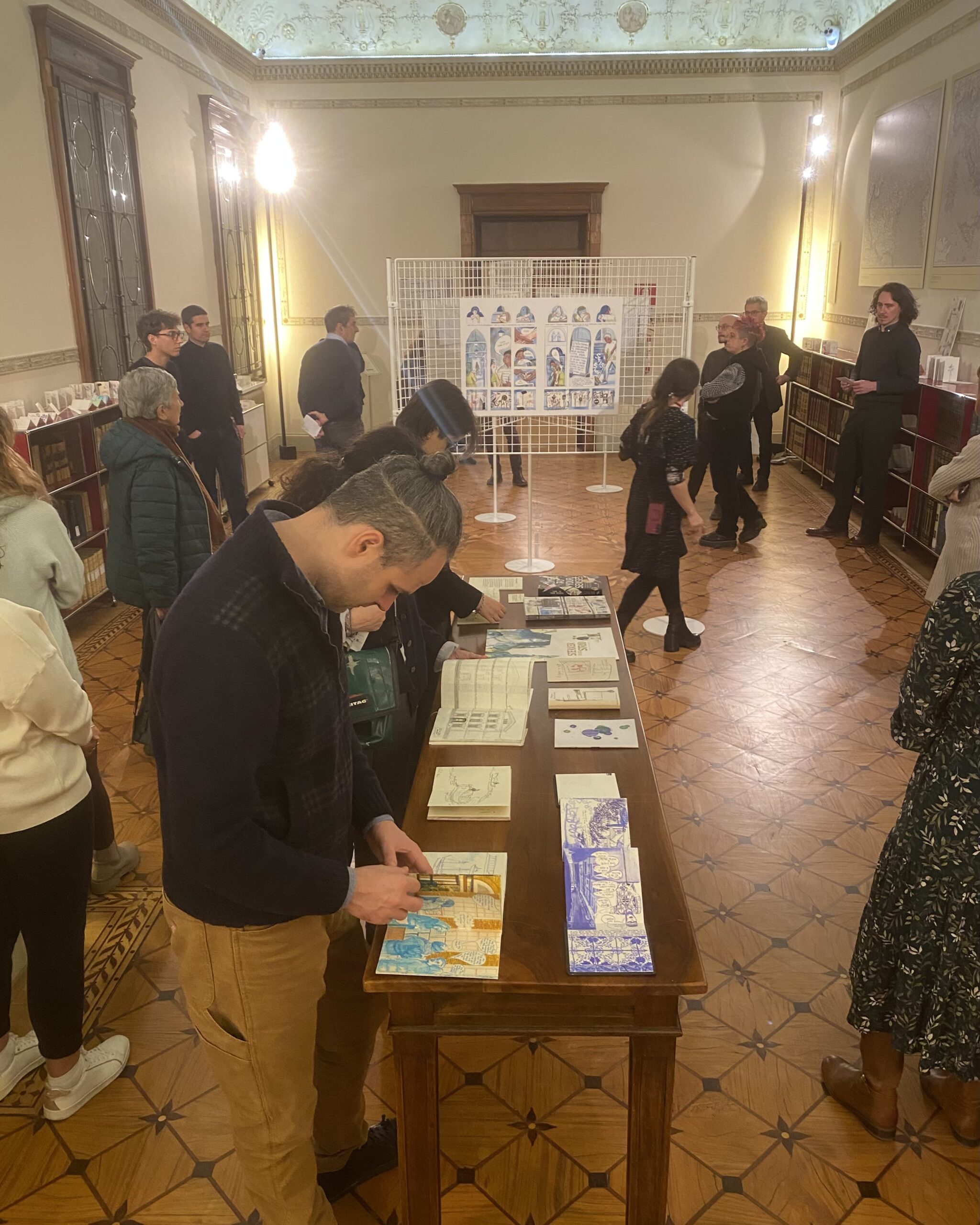
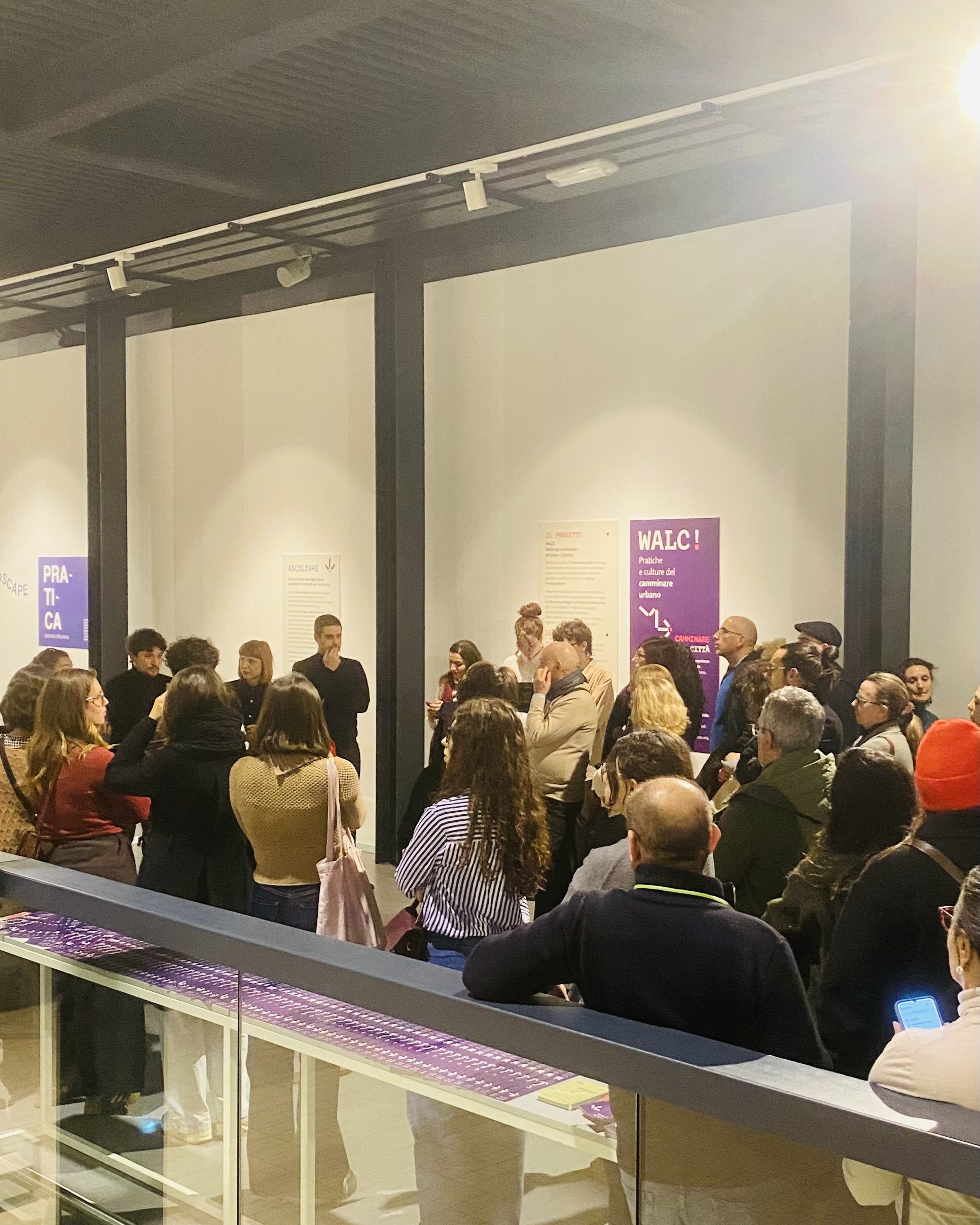
On Thursday, January 15th, concluding the international conference “Urban Mobility Cultures: Creative and Narrative Approaches to Moving in the City”, organized by the DiSSGeA department of the University of Padua in collaboration with the Mobility and the Humanities Centre for Advanced Studies, the museum hosted the pre-vernissage of the exhibition Dance Moves. Walking and drawing in the city, by artist-researcher Tânia A. Cardoso and MoHu member Giada Peterle.
The exhibition hosted several works by illustrator and urban planner Tânia Alexandra Cardoso, who explores the poetics of everyday life, using graphic art to question and co-create the urban environment.
The comic story Dance Moves emerges from an interdisciplinary dialogue between architecture, geography, urban studies, and graphic languages, developed over the years through creative workshops, conferences, and jointly conducted lessons. However, it is primarily the most structured outcome of the “walkshop” titled Walking with the city, a walking workshop organized in April 2025 to engage students from the University of Padua, particularly those from the Master’s Degree Course in Landscape Sciences.
This event, and more generally the conference, are part of the WALC – Walking Landscapes of Urban Cultures research project, which involved the Universities of Bologna, Padua, and Milan Bicocca.
The exhibition will be open from 16 Jan 2026 to 15 Feb 2026.
ThiMa - Things that Matter: Mobility and Agency of Everyday Objects in Late Medieval Italy
ThiMa - Things that Matter: Mobility and Agency of Everyday Objects in Late Medieval Italy
MSCA project (September 2025 –August 2027) supervised by Isabelle Chabot: Università degli Studi di Padova, Department of Historical and Geographic Sciences and the Ancient World (DiSSGeA), supported by the MoHu Centre and MobiLab (Call ID: HORIZON-MSCA-2023-PF-01 - Grant Agreement n. 101154204)
ThiMa challenges the assumption that action is a human prerogative by examining how everyday objects served as agents of transformation in late medieval societies. Investigating the boundary between material and human agency is particularly critical for the present, where new artificial intelligences call into question the very essence of being human. ThiMa reflects on these matters from another watershed moment in the redefinition of European material culture. Between the fourteenth and fifteenth centuries, everyday goods diversified and there was a significant increase of objects in circulation. This period can thus serve as a crucial laboratory to explore the impact of ordinary things on people’s social behaviour and emotional life. For the first time, ThiMa examines objects as agents that interacted with individuals, mediating social relationships and moving emotions, (ways of) thinking, and perceptions through their peculiar material language.
To investigate these questions, this project employs a bold new comparative framework in the richly documented but diverse environments of Tuscany and Sicily. This critical move away from siloed approaches to material culture allows us to better understand how socio-economic, institutional, and legal contexts influenced the complex relationship between human and things. The project interrogates a broad range of textual and material sources, using quantitative and qualitative methods, cutting-edge digital tools and drawing on a ground-breaking theoretical framework on material agency. Thanks to this novel approach, ThiMa will profoundly advance our understanding of how humans perceive and interact with their material environment from the medieval past to the present day.
MSCA Fellow:
Serena Galasso
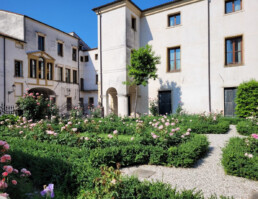
Oggetti agenti: Culture e pratiche materiali nel Medioevo e Rinascimento


2026 Visiting Scholars GRANTS – CALL FOR APPLICATION (by January, 30)
2026 Visiting Scholars GRANTS – CALL FOR APPLICATION (by January, 30)
In the framework of the “Mobilities: A transdisciplinary framework for research, international teaching and public engagement in the Humanities” Department Development Project (PSD 2023-2027), the DiSSGeA (Department of Historical and Geographic Sciences and the Ancient World; hereinafter referred to as “the Department”) is launching a Call for Applications for Visiting Scholars Grants for the year 2026. The initiative provides the assignment of positions as Visiting Scholars to professors, researchers, and early career scholars (postdoctoral researchers, lectures, etc.) from international universities or research centres.
Each project proposal will be awarded with Euro 2,500 net.
Funding requests must be submitted from 19/12/2025 to 30/01/2026 at 1:00 PM (CET), by using the appropriate online form – accessible at this link:
https://docs.google.com/forms/d/1YcNCFWRY2GF9v16B1NP7UdKEMMi1KXucZKU2G7NmuvM/edit
and written in English.
For any queries please contact: research.dissgea@unipd.it.
Results of the Visiting Scholars Grant 2026 – Mobilities Project
We are pleased to announce the winners of the Visiting Scholars Grants 2026, as part of the
“Mobilities: A transdisciplinary framework for research, international teaching and public
engagement in the Humanities” project (PSD 2023-2027).
After a thorough evaluation of the numerous applications received, the Selection Committee has
identified the following scholars as recipients of the grants:
• Mimi Sheller
• Jen Southern
• Sian Bowen
• Anne Conchon
• Angela Smith
We wish to express our sincere appreciation to all candidates for the quality and excellence of the
proposals submitted. The selection was highly competitive, given the high standard of applications.
We thank everyone for their interest in our project and look forward to future opportunities for
collaboration.
The selected candidates will be contacted regarding the next steps.
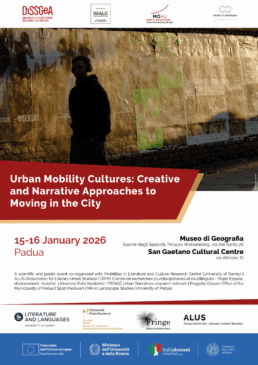

Walking through the ‘autistic city’ - Public book presentation | 24 Oct 2025
Walking through the ‘autistic city’ - Public book presentation | 24 Oct 2025
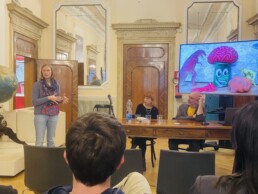
On October 24th, the Geography Museum in Padua hosted a compelling book presentation titled ‘La città autistica’ (The Autistic City). The event, held from 16:30 to 18:00, featured author Alberto Vanolo from the University of Turin, with an introduction by Giada Peterle from our MoHu Centre. Elena Santi, the representative for Accessibility and Inclusion projects at CAM (University Center for Museums of the University of Padua), was also present at the event.
This presentation was part of the NaMUC – Narrative Mobilities of Urban Cultures seminar series, organised within the framework of the WALC – Walking Landscapes of Urban Cultures project. The Paduan unit of the WALC project (PRIN PNRR 2022, funded by the European Union’s NextGeneration EU initiative) is hosted at MoHu.
The event offered attendees a unique opportunity to explore the concept of ‘autistic cities’ and its implications for urban studies and planning. Vanolo’s work likely delves into how urban environments interact with and impact individuals on the autism spectrum, as well as how cities themselves might exhibit ‘autistic-like’ characteristics in their design and function.
This free-entry event not only showcased interdisciplinary research at the intersection of geography, urban studies, and disability studies but also highlighted the University of Padua’s commitment to fostering academic discussions on inclusive urban spaces.”
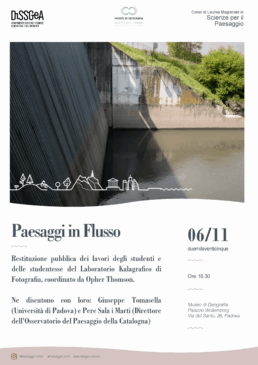
06 November 2025 | PAESAGGI IN FLUSSO public event
06 November 2025 | PAESAGGI IN FLUSSO public event
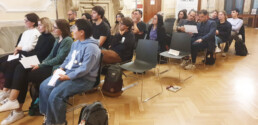
On 6 November 2025, the Museum of Geography in collaboration with our MoHu Centre hosted Paesaggi in Flusso, the public presentation of the photographic works developed within the Laboratorio Kalagrafico di Fotografia, coordinated by photographer and visual researcher Opher Thomson and featuring our Landscape Studies students.
The afternoon showcased a range of visual explorations through which students captured landscapes in motion – shifting forms, changing atmospheres and the subtle rhythms that shape places over time. Their work reflected diverse methods and sensibilities, demonstrating how photography can reveal the fluid and dynamic nature of contemporary landscapes.
At 4:30 PM, the presentation opened into a conversation with Giuseppe Tomasella (University of Padova) and Dr. Pere Sala i Marti, Director of the Landscape Observatory of Catalonia, an established and valued foreign stakeholder of the Landscape Studies programme. Dr. Sala offered insights that bridged research, policy and international landscape governance, enriching the dialogue with his longstanding experience.
Together with the students, the speakers discussed the role of photographic practice in understanding and communicating landscape transformations, as well as the opportunities that arise when artistic, academic and professional perspectives meet.
Paesaggi in Flusso not only highlighted the students’ creative engagement but also demonstrated how both new and long-term partners contribute to broadening the MoHu’s research horizons and strengthening learning opportunities within the Landscape Studies programme.