


Marriage and Mobility in Early Modern Venice
Marriage and Mobility in Early Modern Venice (late 16th-18th Centuries) – Processetti
Postdoctoral project supervised by Jean-François Chauvard (Université Paris 1 Panthéon-Sorbonne) and Walter Panciera (Sept 2020-Aug 2022)
Teresa Bernardi
The research project explores the role played by social ties within processes of migrant identification during the early modern period. The historical and geographical background of this study are the cosmopolitan city of Venice and its domains during the seventeenth century. The research is primarily based on a specific archival source: the so called processetti matrimoniali. This documentation consists in pre-matrimonial enquiries aimed at attesting the marital status, or widowhood, of foreigners and other ‘mobile people’ who wanted to get married in Venice. The project’s hypothesis is that relying on gender as a lens of analysis, along with focusing deeply on women’s mobility, may challenge some historiographical assumptions about the very phenomena of mobility and identification: respectively, the presumed clear-cut between short and long-distance mobility; and the assumed replacement of orality – in terms of reputation and social networks – by written documents.
This research is part of a bigger international programme funded by the French National Research Agency (ANR) and supervised by Prof. Jean-François Chauvard. The research group’s overall objective is to explore the relation between marriage and human mobility both from a qualitative and a quantitative perspective. It does so by comparing the city of Venice, the Greek World under the Venetian dominion and other cities of the Italian peninsula. Moreover, this programme will pursue the digitalization of a vast portion of the processetti in the context of the virtual research environment Geovistory (http://geovistory.com/). In addition to the digital humanities, this project’s research interests thus span various fields of social, legal, and cultural history.


Doing digital humanities @ DiSSGeA 2020/21
Doing digital humanities@ DiSSGeA 2020/21
Dal 13.10.2020 al 11.05.2021
dal 13 ottobre 2020 all’11 maggio 2021 si svolgerà, nell’ambito delle iniziative del MobiLab, il ciclo di seminari Doing digital humanities @ DiSSGeA 2020/2021.
I seminari si terranno il secondo martedì del mese dalle 16.30 alle 17.30 in modalità telematica via Zoom previa registrazione.


Summer School Mobility & Humanities 2020


Bo 2022 Project
Bo 2022 Project
Digital project coordinated by Pierluigi Terenzi, Dennj Solera, Giulia Zornetta, Andrea Martini
“Bo 2022” is an innovative digital project that explores the history of the University of Padua by mapping the academic population who animated its cultural and institutional life from the foundation of the Studium in 1222 to the 20th century. Starting from the previous project PADU-A financed by the DiSSGeA, a team composed of medievalists, early modern and modern historians designed an open-access database by using Nodegoat, a web-based research environment developed to build, manage and visualise large sets of historical information. The project is also supported by the University of Padua, the Center for the history of the University of Padua (CSUP), and the University Museum Centre (CAM).
The “Bo 2022” dataset focuses on the students who graduated at the University of Padua during the past 800 years as well as on professors and other employees. Due to the different sources available for each historical period, the database is conceived in modular and separated sections. Each one contains a wide range of prosopographical information, that may include the geographical origin of the students, the scientific area of their studies, their religious belief, the title of their thesis, the final evaluation and many other aspects.
- The Medieval Age section (1222-1405) maps all the people who had been qualified as having a relationship with the University during the 13th and 14th centuries by using mainly (but not only) the private charters edited by Andrea Gloria.
- The Quattrocento and the “Paduan Golden Age” section (1406-1605) focuses on the students who graduated at the University in that period and were thus recorded in the Acta graduum academicorum Gymnasii Patavini.
- The Modern Age section (1606-1805) collects the academic population of Padua from the last years of Galileo’s teaching period to the Austrian government’s reforms.
- The Contemporary Age section (19th to 20th centuries) maps all the students who graduated at the University of Padua and, whenever possible, their tutors by using both the students’ files and the dissertation records produced, that were produced by each Faculty.
Beside these sections, the database also focuses on some cross-cutting aspects concerning more than one period: the copyists of medieval manuscripts (13th to 15th centuries) who declared in their writings a connection with the Studium of Padua as current or graduated students, and the hundreds of the students’ coats of arms that have been preserved in the Palazzo del Bo as well as in other buildings of the city (15th to 17th centuries).
Starting from the database, the “Bo 2022” research fellows aims to carry out research on the circulation of both people and ideas connected to such an important centre of high-culture and learning. Consequently, the project is strictly connected with the mobility studies and aims to give an important contribution in measuring the attractiveness of the University of Padua in both an European and Global perspective. Beside the database, three books dedicated to specific aspects of the history of the university will be published on the 800th anniversary of its foundation. The subjects include the mobility of students and its consequences on both their career development and the urban life of Padua during the medieval and early modern period; the intellectual, religious and social freedom guaranteed by the university (the so-called patavina libertas); women and the University of Padua.
Equipe of research
- Pierluigi Terenzi (1222-1405 and general supervisor/coordinator)
- Giulia Zornetta (1406-1500)
- Dennj Solera (1501-1806)
- Andrea Martini (19th-20th centuries)
Advisory Board
- Filiberto Agostini
- Andrea Caracausi
- Maria Cristina La Rocca
- Paola Molino
- Carlotta Sorba
- Giuliana Tomasella
- Nicoletta Giovè (manuscripts and copyists)
- Franco Benucci (coats of arms)
Database collaborators
- Claudio Caldarazzo (CSUP)
- Antonella De Robbio
- Elisa Furlan (Borsista “Mille e una lode”)
- Michele Magri
- Manoel Maronese
- Maria Giada Semeraro (CISM)
Some datasets are provided by
- Rossella Bortolotto (CSUP)
- Elisabetta Hellmann (CSUP)
- Remigio Pegoraro (CSUP)
Interns (updated June 2020)
Cecilia Alfier, Nicolò Anegg, Giulia Arnaldi, Luca Bertolani Azeredo, Maria Grazia Bevilacqua, Pavle Bonca, Caterina Borsato, Martina Borsato, Fabio Boscagin, Alex Brodesco, Filippo Bucella, Daniela Buccomino, Riccardo Cantagallo, Alessandro Chinello, Giusy Ciacera Magauda, Manuel Dell’Armi, Andrea Di Renzo, Silvia Di Girolamo, Laura Famengo, Federico Feletti, Lisa Fonzaghi, Rosaria Frisone, Marco Gallo, Maria Cecilia Ghetti, Gianlorenzo Giordano, Martina Greco, Federico Jarc, Gautier Juret Rafin, Giacomo Lago, Tommaso Laganà, Tingyu Lan, Rodrigo Macario, Danilo Marcantonio, Riccardo Mardegan, Alice Mazzetto, Alessio Menini, Mauro Montesani, Michele Mosena, Marta Nezzo, Jérémy Perret, Francesco Piovan, Enrico Rampazzo, Edoardo Ranzato, Gianluca Ratti, Manuela Rivecchio, Alberto Rosada, Alessandro Ruzzon, Luca Sallustio, Francesco Sartori, Lucia Squillace, Luca Tomasin, Nicolò Tomasin, Vladana Trapara, Raffaele Usai, Carlo Vettore, Alessia Visentin, Giorgia Visentin, Matteo Visentin, Michele Visentin, Stefano Viviani, Xinying Wang, Giovanni Zanella, Francesca Zaramella, Piero Zin.

Mobility in Historical Perspective: Oxford-Berlin-Padua Research Network
Mobility in Historical Perspective: Oxford-Berlin-Padua Research Network
Mobility in Historical Perspective is a networking project focused on the theme of mobility from a historical perspective. Students and researchers from the Universities of Oxford, Berlin (Humboldt and Freie Universität) and Padua.
are part of this network, whose participants meet once a year in one of the partner cities to discuss the various facets of the theme of mobility in history (human mobility, intellectual mobility and economic mobility).
Mobility in Historical Perspective provides opportunities to discuss and share knowledge among scholars. It is indeed in international workshops that innovative perspectives on traditional research issues usually arise by challenging established points of view and methodologies.
By adopting a long-term chronological approach, the project shows that mobility has always been a central feature of human life. Moreover, it gives the opportunity to look at the phenomenon of mobility from different perspectives, comparing various historiographical approaches and methods depending not just on the individual formation and preference of the scholars, but also on their affiliation. The meetings of the three academic communities, indeed, demonstrate that there are different angles from which mobility studies can be approached and the project gives everyone the opportunity to get acquainted with the different scholarly traditions of the three countries. At the same time, new approaches which emerge in such environments affect the universities involved as a whole, enhancing the development of new research cultures inside the university itself, thus facilitating academic renewal.
Coordinated at DiSSGeA by:
Andrea Caracausi

Maria Cristina La Rocca

Matteo Millan


Mind travelling with the Museum of Geography during the COVID-19 Pandemic
The MoHu Centre’s social impact activities are carried out in connection with the Museum of Geography of the DiSSGeA Department. During the COVID-19 pandemic, the museum has found creative ways to connect in the current shared condition of immobility by inviting people to re-imagine their mobilities.
Mind travelling with the Museum of Geography
Geography comes alive in places, landscapes, travel and encounters. During the lockdown caused by the coronavirus pandemic, the staff of the Museum of Geography, which has been closed since the end of February 2020, wanted to counteract the imposed immobility with an original initiative designed to open the horizons of our minds and move through stories and emotions.
‘Instead of looking nostalgically at the world we have left‘, comments prof. Mauro Varotto, scientific director of the Museum of Geography, ‘we decided to take advantage of what this difficult situation offers: the opportunity to think over our personal geographies, to recall distant geographies, places we visited and photographed perhaps too hastily, returning to the repository of our emotions related to places to make them live again and share them’.
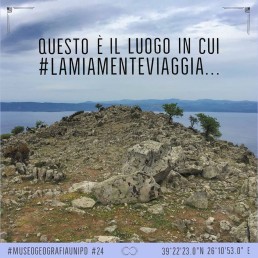
The initiative is identified by the hashtag #LaMiaMenteViaggia (literally: my mind travels) and consists of sharing the places of our own geographical mental explorations. Sparked by the staff of the Museum of Geography, the initiative is addressed to those who, despite the closure, have continued, if only in their mind, to travel to reach the places in their heart.
Every day since the 3rd of March, 2020, educators, teachers and staff of the Department of Historical, Geographical and Ancient Sciences of the University of Padua have shared personal stories of public and private places on the museum’s Facebook and Instagram profiles, accompanied by a photograph and geographic coordinates.
In late May, 2020, the #LaMiaMenteViaggia campaign shared their 100th post, concluding a journey that visited many places in the Veneto region, 15 other regions of Italy, 35 states in all continents and 2 planets (in addition to Earth and Mars).
The initiative has reached over 150 thousand people through social media networks. ‘The initiative was liked’, confessed Giovanni Donadelli, curator of the museum and the initiative, ‘confirming yet again the power of storytelling and showing that there is no lack of stories of precious places, but rather the time on our part to listen to them and savour them. During this quarantine, time has dilated, also reinvigorating our geographies of the heart’.
Everyone can read the stories posted within the initiative by looking for the hashtag #LaMiaMenteViaggia on Facebook and Instagram.

MoHu Media Space
MoHu Media Space
MoHu Media Space is a channel of Media Space Unipd, a video repository powered by the Digital Learning Office of the University of Padova.
Born as an institutional platform aimed at hosting video contents of the University of Padova, it has experienced a mass development during the Covid-19 pandemic, which early affected Italy in late February 2020. Media Space Unipd has functioned as the official repository of all the recorded video lessons held at the University of Padova since early March 2020 (about 140.000 hours in a day).
MobiLab is currently developing the MoHu Media Space Channel as a public repository with various playlists.