

Questioning Food, Mobilities and Development - Students Exhibition | 5 Feb 2025
Questioning Food, Mobilities and Development - Students Exhibition | 5 Feb 2025
On 5 February 2025 the Museum of Geography hosted a thought-provoking exhibition event curated by Chiara Rabbiosi and Ginevra Montefusco, featuring installations created by students of our Master’s degree programmes in Local Development and Mobility Studies in synergy with the “Food communities: ecocultural approaches and postdevelopment perspective”, Next Generation EU, M4 PRIN PNRR P20223SFMN project.
The exhibits and related students’ presentations offered a fresh take on the interconnections between food systems, mobility, and development through innovative and creative lenses. Attendees were immersed in a multisensory experience that challenged conventional perspectives and sparked dialogue.
Kudos to these bright young minds whose works demonstrated a deep understanding of such critical issues and a commitment to experiment with creative methodologies and active learning initiatives around mobilities!


Mapping the perception of the Polytheistic heritage in the city fabric of Ostrogothic/Byzantine Rome (500-750 ca.)
Mapping the perception of the Polytheistic heritage in the city fabric of Ostrogothic/Byzantine Rome
(500-750 ca.)
Postdoctoral project supervised by Prof. Maria Cristina La Rocca (March 2024 -August 2026)
Nicola Luciani
Starting from the last decade of the 5th century, the city of Rome was part of an Ostrogothic kingdom established with the formal consent of the Empire, that consequently maintained strong diplomatic and administrative links with the Italian peninsula. What is more, Byzantium was able to again impose direct imperial rule over the city from the mid-6th century, following Justinian’s wars in the West. From then on, for about two hundred years Rome was under the direct rule of the Emperor’s government, until the gradual waning of Imperial authority in the 8th century.
During such period, despite its peripheral position in respect to the political core of the Empire, the city of Rome was still regarded as a prime ideological centre of the Mediterranean oecumene. A crucial expression of such status within the urban fabric was represented by the Classical monumental panorama. Indeed, under Ostrogothic and Byzantine rule, Rome’s pre-Christian sacred structures were still actively employed to host
important public activities and to transmit civic symbolisms directed to the people inhabiting or visiting the metropolis.
As a central tenet of the project “PagByzRome – administration and perception of the Pagan heritage in the urban fabric of Byzantine Rome”, the city’s Polytheistic heritage is therefore employed to explore the relationship between the city-space and its inhabitants during the entire chronology of Ostrogothic and Byzantine Italy.
Accordingly, data regarding Polytheistic scared structures and sculptures are collected within a map of Early Medieval Rome, with the possibility of accessing information regarding the interested contexts. The map is structured according to a diachronic perspective, presenting layers corresponding to different main phases (Rome at the beginning of the 6th century, under Ostrogothic rule – Rome during the second half of the 6th century, after the Imperial conquest – Rome in the mid-7th century, under Eastern Imperial rule – Rome in the mid-8th century, around the end of Imperial direct control).
The mapped contexts are also presented in relation to prominent ritual routes winding through the city, including processions promoted by secular and religious authorities, such as Imperial adventus or Papal litanies.
The mapped Polytheistic religious heritage within the city fabric is indeed explored in light of its roles in the interactions among the city’s different social groups (including Church hierarchies, Gothic élites, Eastern government authorities, Latin-speaking inhabitants), each characterized by distinctive cultural roots that impacted their understanding of Rome’s Classical structures.


Travel guides exhibition at the Museum of Geography (14 Jan-11 March 2025)
Travel guides exhibition at the Museum of Geography (14 Jan-11 March 2025)
On January 14, 2025 the Museum of Geography at the University of Padua, one of our main partners of social engagement activities, inaugurated a new exhibition titled The World in Hand. Travel Guides in the West from the Modern Age to Today. The exhibition, which is curated by Gian Paolo Chiari and Sara Dotto with the scientific direction of Giada Peterle, Chiara Rabbiosi and Giovanni Donadelli, remained open until March 11, offering a unique look at the evolution of travel guides from the 17th century to the present day. Among the 40 volumes on display, visitors can admire rarities such as the first guide of the Italian Cycling Touring Club from 1895 and the first Lonely Planet from 1973. Created with the contribution of the Library of Geography of the University of Padua and the MoHu Centre, the exhibition is sponsored by the Italian Touring Club. The exhibition was accompanied by a dedicated book and several collateral events.


MAR | Mobile Art Residency Open Call (until 17 Feb 2025)
MAR | Mobile Art Residency Open Call (until 17 Feb 2025)
The MAR Mobile Art Residency call is now open! It promotes the realization of 2 artist residencies in Padua in spring 2025, focused on the theme of urban walking as an act of resignifying space and time. The residencies will lead to the production of 2 site and context-specific works in the Station area, to be inaugurated in November 2025. The call aims to stimulate dialogue between geographic research and contemporary art, exploring walking as: experiential knowledge; an act of poetic and political resistance; reflection on the body-landscape-movement relationship. The residency is a collaboration between DiSSGeA department, the MoHu Centre, the Museum of Geography and Progetto Giovani (Municipality of Padua)and is funded by Next Generation EU in the framework of WALC – Walking Landscapes of Urban Cultures (PRIN PNRR 2022, P2022X5L8B, CUP: J53D2301655001)
Application deadline: February 17, 2025 More info


The mobility of texts: past, present and future
The mobility of texts: past, present and future
“Mobilities” DiSSGeA Department Development Project (PSD 2023-2027)
The research project focuses on the history and future of text and textuality, drawing on scholarship in book history, media and communication studies, and digital history. It takes advantage of the extensive research that has converged at MoHu in recent years to design and implement a teaching program with the Tokyo College on the history and future of the text.
In the summer of 2024, Paola Molino and Federico Mazzini spent two weeks and one month, respectively, at the University of Tokyo, collaborating with Professors Michael Facius and Cintia Vezzani to co-teach the BA course “The Future of the Text.” The central inquiry addressed in this course sought to ascertain whether the “written word,” a concept with a centuries-long history, retains a future within the digital landscape. Contemporary trends, such as the replacement of novels by movies and subsequently video games as the predominant cultural form, the transition from text to audio and video in messenger apps and social media platforms, a concomitant loss of concentration and focus, and declining rates of functional literacy in many developed countries, appear to suggest a negative answer to this question. This is further compounded by the fact that, just a year after the emergence of major language models like ChatGPT, artificial intelligence has already begun to perform a significant amount of reading and writing on our behalf. In this interdisciplinary course, we approached these trends not as absolute truths, but as a point of departure to explore the intricate relationship between literacy, media, and society through a comparative lens. We examined long-term trends in diverse textual media, the evolution of technologies from the printing press to social media platforms, and the social contexts of reading and literacy. This enabled us to contemplate past, present, and future trajectories of textuality.
The subsequent phase of the project entails the execution of the Summer School “The Future of the Text” (June 16-20, 2025), which will be hosted at the Center for Advanced Studies in Mobility and Humanities in Padua and is supported by the Universities of Padua and Tokyo. The Summer School aspires to delve into the historical progression of textual practices and technologies, providing insights and stimulating debates on the present and future of texts. The program will feature a series of traditional lectures on the history of the book, digital history, the mobility of texts and maps, and the challenges of writing English texts in the era of AI. These lectures will be complemented by hands-on workshops in libraries, museums, and exhibitions in Padua and Venice. The Summer School will be offered to international postgraduate students from Padua and Tokyo. It will be a collaborative effort, with instruction provided by Paola Molino, Federico Mazzini, and two colleagues from the University of Tokyo, Michael Facius and Naoko Shimazu. Further details regarding the Summer School, including the call for applications, will be made available on this website by mid-February 2025.
Co-Principal Investigators:
Paola Molino
Federico Mazzini


Fieldwork Video Screening: Landscapes of Coexistence - 27 Nov 2024
Fieldwork Video Screening: Landscapes of Coexistence - 27 Nov 2024
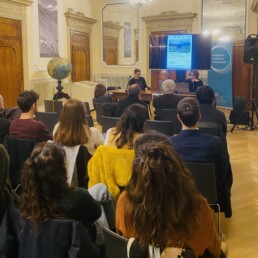
The recent event organized by the Master’s Degree in Landscape Sciences at the University of Padua offered an intriguing perspective on various forms of coexistence in the landscapes of Giudicarie Esteriori.
The event began with an introduction by professors Benedetta Castiglioni, Margherita Cisani, and Roberto D’Alba, who contextualized the theme and presented the work done by students during the 2024 Fieldwork.
The core of the meeting was the screening of three videos created by the students, each focusing on a specific aspect of coexistence:
- The relationship between humans and wildlife
- The dynamics between insiders and outsiders in the territory
- The dialogue between past and future in the landscape context
These works offered an in-depth and multifaceted look at the complex interactions that characterize the landscape of Giudicarie Esteriori, going beyond traditional dichotomies.
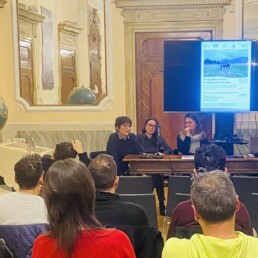
The event concluded with a stimulating round table discussion featuring Carmela Bresciani from the Ecomuseum of Judicaria, Anna Sustersic from the Coexistence Festival (stakeholders of our Master in Landscape Studies), and Sabrina Meneghello from IUAV University of Venice. This discussion allowed for a deeper exploration of the themes that emerged from the videos and further perspectives on coexistence in contemporary landscapes.
The meeting highlighted the importance of an interdisciplinary and inclusive approach in the study and management of landscapes, promoting a vision that goes beyond simple oppositions to embrace the complexity of relationships between different entities and temporalities in the territory.


Herbaria on the move between history and botany: exploring scientific, political, and cultural narratives through Achille Forti's botanical collections (1878-1937)
Herbaria on the move between history and botany: exploring scientific, political, and cultural narratives through Achille Forti's botanical collections (1878-1937)
Postdoctoral project supervised by Elena Canadelli (Dec 2024-Nov 2026)
Project in collaboration with the Botanical Garden of the University of Padua (Prof. Tomas Morosinotto), the Department of Geography of The Royal Holloway Centre for the GeoHumanities (Prof. Felix Driver), the Italian Central Herbarium (Dott. Lorenzo Cecchi), the Natural History Museum of Verona (Prof. Luca Ciancio, Dott. Leonardo Latella), the Museo Galileo - Istituto e Museo di Storia della Scienza, Florence.
Postdoctoral researcher: Claudia Addabbo
This two years research project explores natural history collections and their mobility as interdisciplinary objects, between history, botany and art. The aim is to focus on the figure of the Italian botanist and art collector Achille Forti (1878-1937) and on his considerable Algae Herbarium, today preserved at the Botanical Museum of the University of Padua. It includes around 40,000 specimens of algae from all-over the world, collected by different people and in different scientific expeditions between the nineteenth and the twentieth centuries.
The main objective of the project is to reconstruct the history of the formation of Forti’s Herbarium and to consider its “mobility” in space and time, thanks to an integrated and extensive study of archival material, museological collections and primary literature, in the light of history of science and mobility studies.


